
Can China Say Ho?
Another Confucian Christmas


For four centuries, the West imposed Christianity on China, erasing the rich concept of “shengren” from its cultural history—a practice we must now resist.
Confucius, known by various names like King Kung or Master Kong, is NOT a Christian saint like Saint Nicholas, aka Santa Claus. Instead, he is a Chinese sage, specifically: a shengren in Confucianism, as unique as the buddhas in Buddhism.
Who owns “China”?
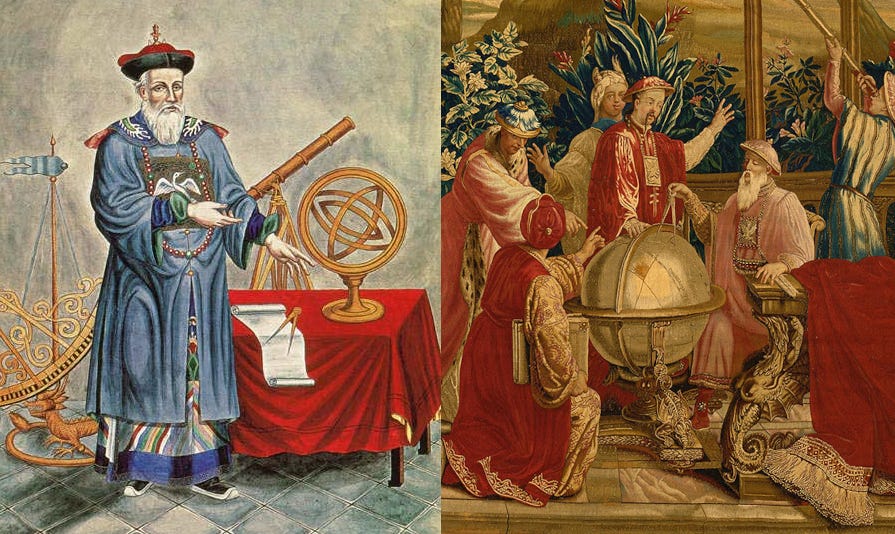
The Chinese shengren, embodying ideal personalities, hold the highest positions in China’s family-based value system.
Regrettably, the term shengren has been meticulously expunged from historical discourse, even within China. In the 17th century, Western missionaries falsely believed Confucius revered the Christian God.
Consequently, they insisted on Christianizing China, asserting, incorrectly, that the Chinese, from their origins following the Flood, possessed true knowledge of God in the Bible. [Little known fact, the Bible has no mentioning of the Chinese people. It’s all about God’s chosen people, the Jews.]
This misinterpretation enabled China’s apparent Christianization, with Beijing now celebrating Christmas in the year 2025 of our Lord, Jesus Christ. However, few in Europe are aware that this year also marks the 2,576th anniversary of Confucius’s birth.
Translating Chinese key concepts into the vocabulary of Western powers not just weakens the originality of tens of thousands of Chinese thinkers, it might also have legal consequences in the future. Already, we see a major shift in America and Europe to weaponize language. It is no longer historians who do the translations; it is now bureaucrats and legal scholars.
I give you an example: The name “China” is a phonetic derivation of zhin-na which was used between the 17th and 19th century by Western scholars. You could see how easy it is for Western legal scholars to lay claim to “China’s History.”